
Blog Tour: Adele Griffin
Today, TeachingBooks.net welcomes author Adele Griffin as she stops by on her blog tour.
“If the child gives the effect another turn of the screw, what do you say to two children?”
“We say, of course,” somebody exclaimed, “that they …
 So I’ve been asked to talk about an element of writing my book, The Emerald Atlas, that I struggled with, and honestly, it’s hard to pick just one thing. I could talk about the number of times I pulled my hair out for imagining that I could write a mind-twisty time travel story. Or I could talk about the difficulty of working in a genre as well-established as children’s fantasy, a genre in which I would be using characters and tropes that readers had seen a thousand times before and it was my job to figure out how I was going to breath new life into those dusty conventions.
 The seed for my newest young adult novel, This Thing Called the Future (Cinco Puntos, 2011), was planted five years ago when I was studying the Zulu language at a university in Pietermaritzburg, South Africa. The Zulu family I stayed with had two young teenage girls—thirteen and fourteen—who were incredibly hard-working girls and always respectful of their elders. Yet the thirteen year old got in trouble while I was there because she was caught kissing her boyfriend at church. Her boyfriend was a man in his thirties.
 TeachingBooks.net is bringing summer reading 2011 to life. Whether you're promoting the program theme of One World, Many Stories, You are Here,Splash! Celebrate Summer, or another topic, the authors and illustrators presented in this month's column are bound to be on your list. From audio to video recordings, TeachingBooks.net has something for you.
 Growing up in Mexico, I learned to speak the language of color at a very early age. “No dar color” is a popular expression that, translated, means an inability to give off color or emotion. Using color and texture helps me to express my identity, my heritage. I've also learned that color is the most direct (emotional) route to the children (and families) who turn the pages of the books I’ve illustrated.
 Many of us have come to the field of education because of our own love of learning. But with all the daily demands on our time, it can be difficult to manage our teaching responsibilities and feed our professional passions.
 Stones for my Father is a book I had been meaning to write for a long time. My mother’s family is South African and I have always wanted to explore that part of my history. I was also interested in the Anglo-Boer War. To me, it is one of the most fascinating and overlooked conflicts of the twentieth century.
  When we stop to listen, poetry is all around us: in the rhythms that we walk, in the music that we listen to, in the natural world we experience. Fortunately, National Poetry Month gives us space to make this a curricular focus.
 By now I’ve written a number of books and have enough distance from them, to see patterns emerge. Looking back, I’ve realized that so many of the children (or mice or other animals) who populate my work use imagination—as play, as an escape, as a tool.
 I have been asked quite often how Stella and Sam became TV stars. What was my role in their transformation? How did I participate in this transformation? Am I happy with the results?
 Every year we ask an illustrator we work with to share their non-book art as a gift to our customers. Yuyi Morales kindly provided the following images and reflections. Please enjoy.
 Recently I've been watching and listening to elementary school students as they engage with nonfiction. The range of topics that excite them is extraordinary and their conversations about their reading remind me how powerful a stimulus books can be to exploration and critical thinking.
 At the end of last year, the UK media reported the pretty disturbing fact: nine percent of British children are leaving primary school with the reading skills of a seven-year-old. As it happens, I’ve met seven-year-olds who are well into the novels of J. K. Rowling, Roald Dahl, and even J. R. R. Tolkien, but the media was talking about thirteen-year-olds—and boys are the worst offenders, naturally—who can’t struggle their way through much more than a tabloid newspaper.
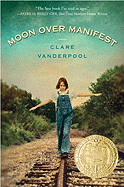 Would you like to listen to this year's award-winning authors and illustrators on their inspirations and influences? In this post, enjoy brief TeachingBooks.net recordings with the 2011 John Newbery, Randolph Caldecott, Michael L. Printz, Robert F. Sibert, Coretta Scott King, Pura Belpré, and Theodor Seuss Geisel medalists.
 Dave the Potter: Artist, Poet, Slave (Little, Brown, 2010) is based on the true story of Dave, a man born into slavery in 1800 who created approximately 40,000 ceramic pots in his lifetime. Dave was owned by six slave masters, but was ultimately sold to a plantation that produced large clay pots. It was on this plantation that Dave was trained to make pottery and became a master potter.